
The Twilight Zone Season 3: Episode 69
"The Passersby" Episode Transcript
Introduction
Welcome to the Key of Imagination. This week, we’re taking a look at the Twilight Zone episode “The Passersby”. We’ll try and get into a rhythm discussing the music in this episode; we’ll try not to stray as we discuss this odd pathway; and I’ll reveal my moment of awe, a rather imperfect look at the importance of imperfection. So, grab your keys, and let’s open up this door to the fifth dimension.
Plot Summary
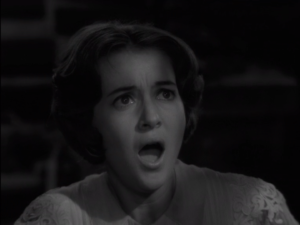
Lavinia sits on her front porch, rocking away, on a particularly hot night, as a parade of soldiers walk down the road, all of whom carry wounds both physical and psychological from the great war between the north and south in the United States of America. Looking to slake his thirst, a sergeant from the confederacy politely asks if he can have a drink from the well of this clearly once beautiful home, now little more than the remnants of the conflict. The answer is yes. The truth is Lavinia appreciates the company. And so the sergeant decides to rest for a while, offering as his payment good conversation and some music from his guitar. All of which helps to drown out the sounds of the good lady’s tears, as she mourns the loss of her husband. Bitterness takes hold of her heart, and she promises the sergeant that she will make some Yankee pay for what has happened to her husband, and when one finally arrives, also looking for some water, it just so happens that this Yankee is the one who saved the sergeant’s life. But, it makes no difference. The crack of the shotgun can be heard, but the Union soldier simply sits upon his horse, unharmed. And then, it comes back to the sergeant. In saving his life, the soldier, this Union lieutenant lost his from fragments of hot metal shooting across his visage. A closer look at the lieutenants face, reveals the truth, but adds an additional mystery. The next morning, our sergeant informs Lavinia that it’s time for him to go, time to get back on the path. He needs to get back on the path. She pleads with him–don’t go. But, the moment is interrupted by a familiar singing voice–Jud, her husband, has returned. But, he bears difficult news. It’s time for the music to stop; time for both of them–husband and wife, to leave. And now Lavinia understands, she, too resides among the no longer living. But, she’s frightened. She doesn’t want to go; she resists. Until a powerful, yet gentle figure takes her by the arm–President Abraham Lincoln. “I’m afraid, too” he admits, but go we must. For I am the last casualty of this war. With these words, Lavinia runs down the path toward her loving husband.
Episode Details
“The Passersby” is directed by Elliot Silverstein. The teleplay is by Rod Serling. And as for our cast, let’s start with our leading lady, the southern bell herself, miss Lavinia, played by JoAnne Linville. James Gregory is our songbird sergeant; David Garcia plays our blinded lieutenant; Lavinia’s husband, Jud, is portrayed by Warren Kimberling. And the 16th President of the United States of America, Mr. Abraham, don’t call me lanky, Lincoln, is brought…cough back to life, by Austin Green. The episode first aired on October 6th, 1961.
Episode Tidbits
As for our tidbits, I found a funny little anecdote on the episode in Marc Scott Zicree’s Twilight Zone Companion. In it, Zicree notes a story from James Gregory who plays the sergeant in the episode. According to Gregory, “On ‘The Passersby’,” I put my belt buckle on upside down, a big ‘C.S.A.’ The director saw it and remarked about it, and I told him, ‘But don’t you see, Elliot, these people are dead, and the buckle upside down indicates that status?’ Well, he gave me a funny look and then, ‘Ah, yes, Jim, I see what you mean. Good touch’” (255). I like this story because it reminds me that sometimes we can take ourselves too seriously, even when we’re in the creative process, which can oftentimes be a serious act. And if we do take ourselves too seriously we can sometimes miss the humor of life that just comes from being imperfect little humans.
Question 1: How do the arts and humanities in this episode amplify its message?
Now, we’ve essentially got two main artistic references within this episode: we have the song that the sergeant continues to sing throughout, which we’ll talk about in a moment. And then there is Lincoln’s reference to Shakespeare’s Julius Caesar. I won’t really be talking much about the Julius Caesar reference, although I did reread it because I thought that I would talk more about it. However, I have to admit: once I started to get into the conversation regarding the music, my mind just sort’ve planted itself there and continued to run. Although, I will just mention a quick little connection that came into my mind regarding Lincoln and Julius Caesar.
So, our President Lincoln in the episode quotes from Shakespeare’s play, and of course he is tragically killed by John Wilkes Booth who was quite an accomplished actor at the time. I was curious if Booth ever performed in Julius Caesar and sure enough, he did. In fact, Booth portrayed the character Marc Antony from the Shakespearean play just five months prior to his heinous act at Ford’s theatre. And, apparently Lincoln was one of the most voracious readers of Shakespeare. “He kept a volume of Shakespeare’s complete works on his desk in the White House, and as a young lawyer, once represented the Illinois Theatrical Company, successfully arguing for the classical origins and worthiness of the art form” (link). So, when our Lincoln in this episode quotes from Julius Caesar, it actually makes sense, given that the real Lincoln would, “read Shakespeare aloud to captive audiences” (link). I wanted to get that information out because I thought it was fascinating and because I hadn’t even realized myself that there is more behind Lincoln’s use of Shakespeare than I had ever really considered.
Now, that being said, I do want to focus much of our attention on this sad but beautiful tune that we keep hearing. By the end of this question, I think we’re going to see that there is also more going on here as well, if we simply listen carefully.
The title of the song is “Black is the Colour” or sometimes the full version “Black is the Color of My True Love’s Hair,” and before we connect this song with our episode thematically, it’s worth taking a quick historical detour, as there is apparently a bit of an interesting mystery regarding its origins. Now, to be completely transparent, Martin Grams Jr. has a little blurb that touches upon some of the items I’m about to mention here, but I actually did my research prior to reading the blurb in Grams Jr., and my research actually uncovered a bit more information, which I’ll share here. But, I do want to give credit to Grams for one thing that he includes that I did not find on my own, which is that one of, if not the, primary reasons they chose the song is because it was in the public domain, and so Serling and CBS did not have to fight about copyright restrictions, which is completely understandable (427).
According to various sources I consulted, the song was first notated by Cecil J. Sharp in 1916 (link) and then published along with Olive Dame Campbell as part of a collection of songs titled English Folk Songs from the Southern Appalachians in 1917. Now, for my clever lads and lasses out there, you’re thinking: wait a second. This Twilight Zone episode takes place around the end of the Civil War, sometime soon after April 15th, 1865, the day Abraham Lincoln passes away. If we take 1917 and subtract it from 1865 (carry the one, add the hypotenuse, and then use the quadratic equation to calculate…) well, this just doesn’t math. Why is our sergeant singing a song that won’t be put to book until another half of a century? Okay, here is where it gets interesting.
An ethnomusicologist by the name of Alan Lomax made a strong argument that the origin of the song actually goes back to sometime in the 19th century in Scotland. According to music editorialist Tom Schnabel, “There's a line in the original version of the song: "I go to the Clyde to mourn and weep / But satisfied I could never sleep," referring to the River Clyde in Scotland. The folk tune made its way across the Atlantic, probably in the company of Scottish immigrants, many of whom settled in North Carolina and Appalachian America” (link). Now, was the song already in America during the Civil War? Don’t know. Did Rod Serling know that this was originally a Scottish song that made its way to Appalachia? Don’t know. So where does that leave us? Don’t know. You know, this is a good lesson for all of my young researchers out there. You can read a bunch of different sources, cross-reference them against others, and at the end of all of that, you don’t really have an argument, but you do have some lovely anecdotes and loosely connected what-ifs to chew on, which can be quite fun. Okay, let’s connect this lovely tune with our episode.
Lavinia has a fascinating relationship with this song. We first see this connection emerge when she tells the sergeant to play loudly enough that it will drown out the sound of her own tears. This is also the first time that we learn that she at least knows the song somewhat because she hums along with it. Later, when she is sitting out front and sewing or mending something, the sergeant starts to play the song again. And this is where something really clever happens in the episode.
She says, “my husband used to sing that song….why I can remember nights, why he’d sit here on this very porch, and he’d play and sing. And the crickets keep quiet..and the bullfrogs down at the pond. Why it was just as if, they’d stop their noise, so they could hear the music.” Now, all the while that Lavinia is saying this to the sergeant he’s doing what? Playing the song. What isn’t she doing? Stopping to hear the song. Pausing to really hear what the music is trying to say. It’s about loss. And later on, what does Jud, her husband, say to her when they meet on the road? “Your life, Lavinia, why, it’s kind’ve like a song. You play it right to the end. And when the notes are finished and they die out, there’s only silence. And that’s when you move on.” And what is her response to all of this? She gets even louder, speaks even more, until finally, and this seems cruel, but I think we can understand why now. Jud just simply leaves her, just walks away. Why? She needs to be alone, needs to be silent at least long enough to recognize what this whole experience means. But, the silence brings introspection, brings awareness. And so the music is necessary to make sure that there are no moments of silence.
So, let’s sum up a few things here regarding the music. The sergeant believes that he is doing right by her by playing the music. But, in reality, and he didn’t know this at the time, he’s part of the reason why she won’t move on. He’s drowning out the necessary silence. How do we know this? Think back to what even the sergeant himself says. In his explanation for why it’s time for him to go, he says to Lavinia, “...sometime during the night, it got quiet on the road there; it got real quiet. And in that quiet, just before dawn, it come to me.”
So, what does all of this mean? A common phrase that we have in life is that we need to stop and hear the music. And it usually means that we need to become more attuned with the present moment of sound, of the world around us. In this case, however, the music is actually serving more of a complex function. When the sergeant is telling Lavinia he has to leave, she won’t stop talking, won’t let him leave. And so, when Jud appears, what is he doing? He’s singing. This grabs her attention long enough to then tell her that it’s time to be quiet. In this sense the music in this episode is incredibly important and reveals a lot of information to us about our characters, about their states of mind, and their awareness of their own situations. I have to admit, I never found the music in this episode to be anymore really more than background filler myself, and so, I suppose I was a bit like Lavinia myself here. I just needed to be quiet enough to really hear the music.
Question 2: Is there something more profound about this road concept than we might initially think?
Okay, confession time: when I was younger, I thought seeing Lincoln at the end of this episode was just about the corniest thing you could have done. How stupid. How meaningless. How on the nose. And as I got older, and this episode would come on, like many of these episodes, my perspective changed a bit with time. And I’m at the point now where seeing Lincoln at the end is anything but corny to me. It’s actually quite perfect and quite sad. I suppose Lincoln is, in some poetical way, the last casualty of the Civil War. Now, our 21st-century modern brilliant minds aren’t fooled here. I have no doubt that there were men and women who passed away after Lincoln whose deaths can be attributed to the war, and yet, there is something that rings true here in the metaphor, so let’s take a moment and discuss the vehicle for delivering this metaphor to us: the road. And let’s ee where this pathway ultimately takes us.
First, I want to begin with something Lincoln says to Lavinia. When he first shows up, he asks her if she intends to stay behind. He then adds, “maybe, maybe that’s not so wise.” And there is a very serious look on the face of the President, as if there is something at stake for those who do not take the passage as they should and when they should. In fact, and here is where we have to give our director George T. Clemens a tremendous amount of credit for this beautiful little bit of blocking that he does with the actress playing Lavinia. When Lincoln says, “I guess you could say, I’m the last casualty of the Civil War.” Lavinia’s first move is to go behind Lincoln as in she positions herself as the last casualty, but she isn’t. Lincoln tells us, “And I’m the last man on this road,” which means that if she stays in that position, behind Lincoln, something is going to happen. In other words, there are stakes involved here. But, what could those stakes be? That’s actually a sub question here that I also find to be rather intriguing.
Something you might have keyed in on as you watched was this problem of thirst. Both the sergeant and the Union soldier are thirsty and looking for some water. Now, this is actually really important because it signals to us that these individuals on the road still have needs, desires, yearnings, and even drives. The body signals we need water. The brain tells us we desire it. And we seek it out to slake our thirst. We know that this road is a path for the dead, and yet, these people yearn. That is actually pretty horrific if you think about it. We’ve been so overrun with zombie stories for the past 20 years that it has become difficult to discuss them without sounding a bit trite or cliche, and yet, let’s actually do so for a moment–I don’t mean get trite and cliche, I mean talk about zombies.
What do zombies want? Braaaaains. Well, it varies of course from cinematic/television universe to universe, but the old tried and true is that zombies want brains. But, the specifics of what they want is actually not that important. When talking about zombies, sometimes we can miss the forest for the trees. You can make a solid argument that it’s the fact that they yearn at all that is most horrifying–that they are being led solely by this need for something that, not only do they not have, but that will never really satisfy the drive for it. And this is why zombies often work as a nice proxy for rampant consumerism. What do we want: IIIIIIIPHONE! And then we get it, and it doesn’t really satisfy our want, at least not completely. We want the next thing, never quite being satisfied with the fact that we have a computer in our pockets that is 10x more powerful than the one used by NASA to get us to the Moon. Chew on that, my fellow zombie friends. [Joe, you’re starting to make me yearn to change the channel. What does this have to do with the Twilight Zone]
Fair enough. You know I always appreciate your patience with my meanderings, and I always come back, eventually–like a zombie. [Oh, come on. That’s a good joke. I’m proud of that one.] . Let’s connect this up with our question and episode. There is something peculiar about this road in the Twilight Zone. It would be one thing to have it simply be men and women who passed away during the Civil War. But, adding the element of desire tells us that this is not a path that you want to be on. There is no rest to be found here; there is only pain, desire, and fear. And yet, for some reason, they have to take it. Why? Well, there are a few ways that we can look at that part of the question. The most positive way to look at it is that, this is a kind of purgatory, a space for cleansing of the mortal wounds and desires that leads to something greater eventually. How can I make such a claim? Think about the interaction between Jud and Lavinia. Judd clearly understands that there is something more positive at the end of the path. He confidently moves toward it and wants to usher his deceased wife, whom he clearly loves, toward that way so that they can be together. [That’s beautiful, Joe. It’s a love story.] Well…
There is something a bit sinister about this road that we have to acknowledge. Remember, when I did all that talkin’ and fussin’ about desire and zombies. Umm…let’s take a closer look at what the sergeant says to Lavinia. He can’t really explain what it is that is pulling him toward the road, but, he says, “there’s something down at the end of that road, and I’ve got to find out what it is.” That’s not necessarily peace; that’s, once again, unrequited desire. And then you look at the way Jud leaves Lavinia. He turns away from her. He stares down at the end of the road, as if that’s the thing that is most important–not his love. In truth, he looks like a zombie. Yes, he does wait for her at the end, but I think we know that if she hadn’t gone to him, and Lincoln had continued walking past Lavinia, I have little doubt that Jud would have walked right through to the other side and just left her behind. [It’s still a better love story than Twilight, Joe.]
That may be so, my friends. But, and here is where I have to admit, I might be flat-out wrong. I don’t feel confident in the fact that what is on the other side of the road is a good thing. The fact that these soldiers and Lincoln seemingly HAVE to come through this way, and they clearly still feel pain, and hunger, and then to add to that a burning desire toward reaching the end of the path, this does NOT sound like a particularly good ending to me when you break it down, and yet, and I would be remiss if I didn’t mention the following: Serling wrote this teleplay, and he certainly knew what it felt like to not only see the young men around him when he served in the war get hurt or worse, but he was one of them himself, taking shrapnel in his knee that would impact his stability for the rest of his life. And I certainly don’t think he would send the soldiers and women off to a place that would not provide them with respite from their sufferings, so I’m going to assume that at the end of the pathway is a kind of a salvation, a place of peace. I think Serling would intend it to be that way.
Question 3: What are your moments of awe?
As for my moment of awe, I want to point out something interesting, something that connects some of the things we talked about in question 1: the arts, more specifically the music. So, we talked a bit about the song “Black is the Color of my True Love’s Hair.” Now, if you scour the internet, you can find all manner of approaches to this song from the more traditional Pete Seeger, to the beautifully melodic Nina Simone version, to faster more rhythmic versions. And after listening to a bunch of them, I realized something, something really odd. My favorite version is actually this one in the Twilight Zone. Why? You know, if I were still a music major–which I gave up after one year of music school. That’s right; I’m a music school dropout, a recovering alto saxophone player to be precise. If I were a music professional, I would probably look at the music in the Twilight Zone, I mean beyond the Bernard Hermann or Marius Constant themes, which are absolutely legendary. However, after a while I figured out why I like this version the best: I love how imperfect it is. The guitar is slightly out of tune, but the vocals come through beautifully strong. I’ve talked about it before, but as we move through this current phase of AI, more and more, I genuinely believe that people will begin to respond more positively to and even demand arts that are imperfectly human. The autotune, the perfectly painted pictures, the tightly written scripts–all of that will start to taste like vinegar in our mouths. And only the slightly off, the tragically imperfect arts will be what we clamour for. And there will be no performance anxiety, because the performance, the in-the-moment intimate interaction and symbiotic creative experience between performer and audience, that will be the only thing that matters. We’re not there yet, but I can see it coming down the pathway as clear as good old Honest Abe himself.
My Rating.
As for my rating, I would give this episode a solid Middle Middle-Tier. I like it. I don’t love it, but there is something about it that I find enjoyable and entertaining, and at the end of the day, isn’t that really the goal. We’ve got good performances all around by the actors. If I were staring at an empty bowl of nachos during a marathon run, would I get up during this episode and reload? Well, yeah…I think I could see myself doing that, which is why it stays somewhat mired in the middle tier.
Next Episode
Next time,we’ll be taking a look at the Twilight Zone episode “A Game of Pool” and here are your questions to consider when watching the episode:
Question 1: What can we actually take away from the message about greatness in this episode?
Question 2: Is there a way for us to determine if Fats Brown is a good, evil, or neutral entity in this episode?
Question 3: What are your moments of awe?
Announcements and Shout-outs
I’ve got two important announcements here.
I’ve got a couple of new members in our Twilight Zone key koi partner plan that I would like to personally thank for their support. Jeremy Levy over on Patreon and DueP_Dog and GarrettNorth over on the YouTube channel. I am incredibly grateful to all of you for joining, and keep in mind, 50% of every penny you give, after the platforms take their percentages,is going to charity. And I just want to add something and make it very clear. I am under no false pretenses about the fact that that things are hard for a lot of people, and so believe me when I say that I genuinely appreciate your support. And even if you feel like you can’t sustain the $2.99 monthly donation. I will never remove your name from the list of people who have donated. If you give a dollar once, you’re forever on the list of people who have supported our efforts to provide additional resources to these organizations. And honestly, all of you out there who do the liking, the subscribing, and the watching, you are represented in this as well. I just made the 2nd payment of the year to these charities, and when I fill out the donation form, I put The Key of Imagination Show on it. That’s because of all of you. So thank you to everyone–literally all of you who continue to watch and interact with the channel. This is a fantastic community of thoughtful people.
Okay, announcement number 2: Serlingfest. I will be there on Friday night to support Tom Elliot who does the Twilight Zone podcast, which is top-notch when it comes to shows about the Twilight Zone. He’s going to be doing a live episode on “The Masks”--you know, the episode where this handsome face comes from. Tom works incredibly hard on his show, and I would like to be there to just be another smiling face in the crowd. However, I don’t think I’ll be staying the night on Friday. I’ll probably be zipping back to Albany. I will be back in the morning, however, for Saturday, and I’ll probably stick around and head to Recreation Park on Sunday morning as well. Now, in terms of organization for people who might want to get together for lunch on Saturday or something, I will say this: although the KOI Discord does not get the love that it probably should throughout the year, this is really where it shines. I’ve created a forum in the Discord specifically for Serlingfest 2026 where we can communicate and organize as needed. This has worked well in the past, so let’s keep it simple. If you are able to go to Serlingfest, use the link in the episode notes or on the YouTube channel homepage to get on the Discord. Now, if you don’t want to use the Discord, that’s fine with me. If you see me there, don’t be afraid to introduce yourself. One of the fun things about Serlingfest is just talking with other people who love the Twilight Zone.
How to Support the Show
Want to support the channel? Consider subscribing, liking, commenting, and sharing the show with a friend–you know all of the usual algorithmic gymnastics, that will help us expand our awesome community of Twilight Zone fans. Plus, you never know, I might just highlight your comment in an episode of the show–as long as it's family friendly. And if you want to be immortalized on our list of key KOI supporters, consider joining one of our membership tiers on YouTube or Patreon. I’ve got additional content videos that analyze Twilight Zone episodes from the 1980s, the early 2000s series, and the Jordan Peele 2019 series. Additionally, 50% of all money taken through this channel, after the platform fees, is going to charity. 25% to the Rod Serling Memorial Foundation, and 25% to the Gary Sinise foundation. For more information about me, my scholarship, and the show, head over to the keyofimagination.com. That being said, even if you hated every minute of this, I’m still going to thank you for spending some time with me. Until next time, remember, all doors are open to those who possess the key of imagination.
Works Cited
Martin Grams. The Twilight Zone : Unlocking the Door to a Television Classic. OTR Publishing,
2008.
Rizzo, Rodrigo R. N., and Mark P. Jensen. “Hypnosis in Chronic Pain: From New Hope to
Emerging Standard?” Pain (Amsterdam) [Philadelphia, PA], vol. 167, no. 7, July 2026, pp.
1498–507, https://doi.org/10.1097/j.pain.0000000000003944.
Zicree, Marc Scott. The Twilight Zone Companion. Second edition, First Silman-James Press
edition., Silman-James Press, 1992.