
The Twilight Zone Season 1: Episode 19
"The Purple Testament" Episode Transcript
Introduction
Welcome to the Key of Imagination. This week we’re going to be looking at the Twilight Zone episode, “The Purple Testament.” We’ll look at how Shakespeare’s King Richard II connects with the story; we’ll think about what it means for Fitz to have this supernatural power; and I’ll reveal to you my moment of awe. So, grab your keys, and let’s open up this door to the fifth dimension.
Plot exposition
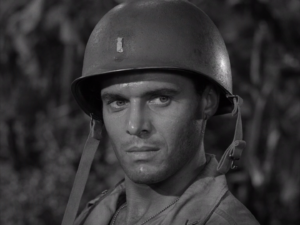
The stage is the Pacific theater, WWII, a place that Rod Serling knew intimately as a paratrooper with the 511th. In this story, Lieutenant William Fitzgerald, Fitz for short, has just come back from a mission, but he’s more shaken than usual. When Captain Riker sits down with the lieutenant to find out what has himso rattled, Fitz tells the captain, we lost four men on the mission: Hibbard, Horton, Morgan, Levy. Now, in the midst of war, many men and women are lost, but what makes these four particularly of interest is that Fitz knew the day before that they were not going to make it out of the mission alive. He could, quite literally, see it in their faces. Somewhere, at some point in time, Fitz picked up a gift–or rather a curse–the ability to see if a man’s death was on the immediate horizon. And when orders came down from above for Captain Riker to go on a mission, Fitz begged him not to go, but Riker, being the leader that he was, insisted. And when it was over, the army was short one more captain. When Fitz receives a bit of good news, that he will be leaving the combat zone to go get some much-needed rest, as he catches a glimpse of himself in the mirror, he sees the same glow on his own face, that lit the visage of Captain Riker. Fitz never made it to the facility, but he did find a place for rest.
Episode Details
“The Purple Testament” is directed by Richard L. Bare. The teleplay is by Rod Serling. And as for our cast, William Reynolds plays our main protagonist, Lt. William Fitzgerald; Dick York is Captain Riker; and Barney Phillips plays Captain E.L. Gunther. The episode first aired on February 12, 1960.
Episode Tidbits
As for our tidbits, I’m going to read a short section from Anne Serling’s book, As I knew Him, which is a fantastic read. If you haven’t picked up a copy, I encourage you to do so.
Although my father’s physical wounds are a daily reminder of the war, they pale against the emotional scars he and many war veterans endure. He turns to writing as catharsis. Like many writers of his generation, the war continues to provide material and motivation throughout his career. (70)
I want to take a second and point out something that Serling came to know on his own, without help. Writing is not simply the production of words; writing is thinking; it’s an attempt to place narrative order on the chaos of our thoughts. If you’re struggling with something, and you just can’t seem to crack what is going on, write about it. Don’t try to write something perfect; write your way to a narrative, a story, that is as coherent as you can make it. It’s one of the reasons why we write in journals, diaries, and often as a part of therapies.
In this episode, Fitzgerald names four men who died in the mission early on in the episode: Hibbard, Horton, Morgan, Levy. Two of these names appear in Serling’s short work, “First Squad, First Platoon,” which was a previously unpublished work by Serling until The Strand Magazine published it, with permission of the Rod Serling Memorial Foundation and the family. I encourage all of you to pick up a copy of the magazine if for no other reason than to support the hard work of Andrew Gulli and the people who made this happen. It’s really quite a jarring and moving piece by a very young Serling, just fresh out of his service, around 22 years old, attending Antioch College. All four of these names were real people that Serling knew in his time in war: Melvin Levy, Warren Hibbard, Newell D. Morgan, and John Horton were real men that Serling knew from the war who were killed in action, but here they are. And that is also what stories do; they immortalize us, as long as we keep telling them. We’ve known this for thousands of years, and it’s still very much true today. When we lose someone we love, the hurt does not go away; it simply gets pushed to the side, compartmentalized with all of the day-to-day things that we need to accomplish. However, do not forget to tell stories about them, to laugh, to cry, to remember that you were blessed with a unique position of having known that individual.
My initial Thoughts
My initial thoughts on this episode are somber. War is a complex, sensitive topic. And the more you read into Serling’s experience with war, you begin to see these war episodes a little differently. It’s a tough episode to watch, but I like it. There’s a lot of dark, brooding themes in my specific area of literature, that being early American literature, and Serling definitely has a bit of that in his works, which I think speaks to me at times. And even this episode has a bit of that in it, the whole idea of whether or not Fitz’ abilities are a curse or gift. That’s right up the dark Romantic alley, and although I like that part of the story, it doesn’t make it any easer to know that there is more truth in this fictional story than we might initially think.
Question 1: Why does Serling invoke Shakespeare for this episode?
I want to be clear about something from the get-go. What I’m about to do with this question is simply my own interpretation of some of the themes that I think Serling might have had in mind when he invoked Shakespeare: these aren’t the exact, settled thoughts of Serling. They are my own. That’s an important distinction to make because it might be the case that at some point someone, maybe even myself, can dig deeper into Serling’s reading habits and get an even more accurate interpretation of his use of Shakespeare, but for now, we are going to simply look at how I think the Twilight Zone episode connects with Shakespeare’s play, King Richard II.
Let’s talk about reading Shakespeare for a moment. There are really two ways to read Shakespeare. You can read them as plays, with characters, staging, even historical context for some of them. That’s how I think we’re usually taught to read them in junior high and high school. But, there is another way. It’s what we might call close-reading. This is more like how I do it, and, at least for me, it always creates much more excitement and potential for awe. Now, what’s the difference? Close-reading does not ignore the plot; what it does is it favors looking at the language in the context of a broader scope of humanity. So, when we read Hamlet’s famous, “to be or not to be, that is the question.” A close reading would break down those words and then try to see how that connects us with humanity. In this case, we might focus on the term “be.” And we might ask, what does it even mean to exist? Or what does it mean to not exist? Those questions have nothing to do with the play itself, not in the traditional sense, but, in my humble, non-Shakespearean scholar world, it’s the most enjoyable way to approach Shakespeare. I was taught by a great close reader as an undergraduate Dr. Marc Ricciardi, and he passed that on to me. Now, I pass it on to all of you as well. I’m not saying it’s the only approach, or that it’s the best; it’s merely an approach to reading literature.
Here’s a super, super quick plot synopsis of King Richard II. We’re only going to focus on two main characters for our synopsis: King Richard and Henry Bolingbroke, who would later become King Henry IV. At the beginning of the play, Bolingbroke approaches the King to inform him of potential embezzlement and plots to kill the Duke of Gloucester by Thomas Mowbray. To settle the charges, Mowbray and Bolingbroke agree to fight. King Richard, however, has a different plan. He exiles Mowbray from England forever and Bolingbroke for, at first, 10 years, but then it’s bartered down to 6. Meanwhile, King Richard has his sights on war with Ireland. Bolingbroke defies the orders of the King and returns to the land upon the death of his father. You see King Richard seized the land and goods of Bolingbroke’s family, and Henry wants it back. To make a long play, a bit shorter, Bolingbroke is not only able to get his lands back, but he gets the crown, and King Richard ends up dead.
Now, that does not do the play the justice it deserves. It has been quite a while since I read Richard II but as I was re-reading it for this episode, I was reminded of how good it is, so of course, I recommend giving it a full read.
Okay, that’s the plot-ish. Let’s dive down a bit deeper into a particular theme that we can use.
Many people are probably aware of the notion of the divine right of kings. This essentially means that the hand of God himself appoints the king to rule over the people. So, if you’re against the King, you are, for all intents and purposes, against God. That theme plays an important role here as well. Here is King Richard himself talking about it.
King Richard: “Not all the water in the rough rude sea / Can wash the balm off from an anointed king; / The breath of worldly men cannot depose / The deputy elected by the Lord: / For every man that Bolingbroke hath press’d / To lift shrewd steel against our golden crown, / God for his Richard hath in heavenly pay / A glorious angel: then, if angels fight, / Weak men must fall, for heaven still guards the / right” (King Richard II, III.ii.54-64).
What’s fantastic about this section is the idea that, if God is for us, who can be against us? The angels themselves will go to war on behalf of King Richard. And the weak men who dare stand against the Lord’s army, shall certainly fall. There is a moment, however, where Richard begins to question what is happening, and thoughts creep in about Bolingbroke being able to usurp his throne with a great army. Those thoughts are quickly banished, however, and Richard says the following:
King Richard: “I had forgot myself: am I not king? / Awake, thou coward majesty! Thou sleepest. / Is not the king’s name twenty thousand names? / Arm, arm, my name! A puny subject strikes / At thy great glory. Look not to the ground, / Ye favourites of a king: are we not high?” (King Richard II, III.ii.83-88)
The king’s name is worth 20,000 names. What does that mean on both a practical and metaphorical level? With a single word, the king can send 20000 troops to go fight; it’s by his name that he can do so. But, on a more metaphorical level, the king’s right, his divine right, is worth more than even 20000 men. His name alone can strike fear in the hearts of his adversaries. It’s all quite fantastic stuff.
Bolingbroke has been wronged. His rightful lands and titles have been taken from him after the death of his father. Toward the end of the play, when he’s at the castle and Richard is still inside, holding on with no hope of getting anything back to his advantage, Bolingbroke says the following: I’ll paraphrase first and then quote: I’ll lay down my arms right now provided that King Richard ends my banishment and restores my lands. Then he states, “If not, I’ll use the advantage of my power / And lay the summer’s dust with showers of blood / Rain’d from the wounds of slaughter’d English / -men” (King Richard II, III.iii.42-44).
Bolingbroke is able to win people to his side, and the more people he wins over, the more his own name begins to grow in power.
Now, let’s make our way to the actual verse that is the inspiration for the title of our Twilight Zone episode. When King Richard emerges from the castle, he gives the following speech to the Earl of Northumberland,
my master, God omnipotent,
Is mustering in his clouds on our behalf
Your children yet unborn and unbegot,
That lift your vassal hands against my head
And thread the glory of my precious crown.
Tell Bolingbroke–for yond me thinks he stands–
That every stride he makes upon my land
Is dangerous treason: he is come to open
The purple testament of bleeding war;
Okay, pause for a second. When people talk about this line they tend to stop right there, but you can’t. You don’t really get the fullness of what King Richard is talking about unless you include the rest of the speech. Here is the rest of that speech.
But ere the crown he looks for live in peace, /
Ten thousand bloody crowns of mothers’ sons /
Shall ill become the flower of England’s face, /
Change the complexion of her maid-pale peace /
To scarlet indignation and bedew /
Her pastures’ grass with faithful English blood. /
(King Richard II, III.iii.85-100)
These lines are beautiful, courageous; they stir up passions, even a feeling that one would like to be a part of something so big and seemingly so meaningful. To take sides and fight for one’s king or to fight for the right for another to be king. And I think that this, whether consciously or subconsciously, is what Serling saw in Shakespeare and other great writers after he returned from his service in the war. Both King Richard and Bolingbroke have speeches where they offer up the blood of their people as a collective. What is lost are the individuals. From what I’ve read about Serling’s war experience, he doesn’t seem to me to be sorry that he fought; he was proud of his service, and rightfully so. I think Serling’s point here is that these speeches where the individuals become the collective are too easy, too beautifully sculpted for us to even maintain a proper vision of what happens when the collective is moved into actual combat.
When we turn to our episode, we can actually hear this from the man himself. In the opening narration of the episode, we’re shown a bunch of young men coming off the back of a military truck, and each one gets his own moment in front of the camera. And here is what Serling tells us, “These are the faces of the young men who fight….for this is the province of combat, and these are the faces of war.” Serling, and director Richard L. Bare, in a rather brilliant choice, moves us from the collective to the individual. He forces the audience to bear witness to the specificity of those who are participating in the war. Again, I don’t think this is about shaming people. It’s about saying, we must always remember that when we move young men and women into combat, it can’t be with the thought of them as a collective; we must always remember that these are individuals and do everything in our power to see that it does not come to war unless it is absolutely necessary. Great war speeches, like those from Shakespeare, are beautiful and incredibly powerful, but they can have the effect of making us forget that within that collective call are real individuals, real men and women, and we cannot lose sight of that truth.
Question 2: What does the supernatural element add to Serling’s message here?
I’m someone who loves comic book heroes. I work Batman and Superman into conversations where they don’t make much sense because I believe in the idea that super heroes give us a way into better understanding what we can actually achieve as mere human beings. In the case of Lt. Fitz, he’s been given a kind of super power–at the end of the day, that’s what it is. He’s able to know who is going to die just by seeing a glow on the faces of the men. That should prompt us to think about two questions:
Where does it come from?
What should be done with it?
In terms of the first question, where it comes from, in this instance, it’s likely only two places: The Twilight Zone or God. Either one serves the same purpose. It seems to have come from outside of Fitz and by something that is greater than us mere humans, which means it has been bestowed upon him.
As for the second question, what should be done with it, that is much more complex.
Let’s dial into specific scenes to get a better understanding of this. When Fitz and Captain Riker talk in the tent the first time, Fitz says to Riker, “it’s a mark of a good officer, isn’t it? To ward off trouble by anticipating it.” Here, Fitz has the ultimate way of warding off trouble. He can actually see the future, somewhat. And yet, this has arguably made him worse for it. When he’s confronted by the medical officer, he begs for his eyes to be gouged out like Oedipux so that he no longer has to bear the weight of this ability.
But, what is really going on here? Serling is tapping into something that we’ve understood on a species level for thousands of years–it’s something that the dark Romantics of the 18th and 19th century, authors like Byron, the Shelleys, and then in America people like Hawthorne, Melville and even Emily Dickinson, knew how to articulate better than others: that there is something to the concept of the Garden of Eden, of Pandora’s box, of any of the cultural stories that talk about the fact that not all knowledge is created equally. That there is such a thing as the burden of knowledge. In Fitz, we are seeing just a small part of what can happen when a human carries the weight of a knowledge that man seems unable to bear. Now, that’s just one part of this equation. There is also the soldier part of this, which is quite important.
All along, Captain Riker is the man who is the most concerned about Fitz. He genuinely tries to help the Lt. And then, at about the mid point of the episode, Fitz reveals that he sees the glow in Riker’s face–and even tells the Captain, “you better not go.” At this point in the episode, I think Riker believes him. The human reaction that makes the most sense for Riker, I think, is for him to lose himself in the moment, to shake his fist at God, at fate, at every man who pronounced orders from above him. We would accept this reaction as being well within the limits of our understanding of the human in crisis. But, he doesn’t. He takes out some pictures of his family, removes his wedding band, and leaves them on the table. He then proceeds with his mission. I think this is also Serling’s message about the soldier. There is always this present feeling that something terrible can happen at any moment, and yet, they move forward; the soldier becomes a kind of Romantic hero, a person carrying the weight of the burden of knowledge, and yet perseveres. But, that weight is heavy; and it cannot be carried forever. We need to do a better job of letting our soldiers know that when we welcome them home, it’s okay to put that weight down, or to let us help you carry it.
The supernatural element of this episode, Fitz’ ability to see who is going to die, is, I think, a reminder of two things: one, there is a limit to what the human mind can bear in terms of cosmological knowledge. Now, I don’t mean that we should stop trying to learn about the world and our universe. That’s not what I mean. I am referring to the type of knowledge that the Romantics knew as a kind of dark knowledge. Secondly, I think Serling was showing us that there is almost a kind of supernatural gift that goes into the mind of a soldier when he or she goes into battle, a kind of strength to be able to carry that Romantic knowledge, and persevere. However, it often comes with a heavy price, one that sometimes requires help from the rest of us.
Question 3 What are your moments of awe?
I’m always in awe of the people who serve in the military, especially in times of war. My grandfather was in the Army in WWII, and he certainly saw some things that changed him–although he was always kind to me and my sisters. There are a lot of actors in the Twilight Zone who served in the war, and they came back to become writers and actors. In this episode, you have Barney Phillips who served in WWII, and of course Serling himself. I do wonder sometimes if acting or writing, professions that allow people to tell stories and be creative, helped get a lot of these men through hard times. Obviously, this is no replacement for good medical care, but I think telling stories and being creative helps–Serling certainly believed so.
My Rating
As for my rating, I give this episode a very solid middle middle-tier. I think more could have been explored with the concept, but the concept itself is quite good, and you do get a sense of just how much such a gift would weigh on the shoulders of someone who has to issue commands to young men to fight.
Next time, we’ll be taking a look at “Elegy” and here are your questions to consider as you watch.
Question 1: What is the rationale behind Wickwire’s ultimate decision?
Question 2: Why might people choose to be preserved like this on an asteroid?
Question 3: What are your moments of awe?
Closing
Another episode in our proverbial Twilight Zone book, but a difficult one. When talking about something so intimate as war experiences, I always want to do my best to be truthful and respectful. I also hope to represent Serling as honorably as possible. We have a few war episodes in the Twilight Zone, so if I didn’t get it just right here, I’ll keep working on it for the next one.
Announcements and Shout-outs
I’ve got an announcement this week: I’ve purchased my tickets for Serling Fest, which will be held in Binghamton on Friday the 13th through Sunday the 15th. Now, I don’t think I’ll be able to go on Friday because I’m teaching on Fridays this coming semester; however, I should be there on Saturday and hopefully Sunday as well for the unveiling or commemoration ceremony of the Rod Serling statue in Recreation Park. If you’re around and looking for something to do that weekend, take a trip and come see the festivities. And if you see me, don’t be afraid to come over and say, “hi.”
How to Support the Show
Head over to thekeyofimagination.com to continue our conversation. You can rate this episode, learn more about me, watch previous episodes of the show, and check out my curios page where I showcase some of the Twilight Zone trinkets I’ve bought over the years. I encourage people to email me thoughts and comments, whether it’s about a particular Twilight Zone episode, your rating for an episode, or about the Key of Imagination Show. You can get those to me as a text email, an audio clip, or even a video clip of roughly no more than 5 minutes to keyofimaginationshow@gmail.com. Keep in mind, even though we talk about some serious topics, we’re trying to maintain as family-friendly of an atmosphere as we can. If you would rather I not use your comments on the show, please indicate that so I can respect your decision.
If you enjoyed the show, I ask that you please take a moment and do one of the following to help build our community. Rate the show, review the podcast, leave comments, thumbs up, all of the usual algorithmic gymnastics. That will help get the show in front of more people and help us build our community of Twilight Zone fans. However, even if you do none of that and absolutely hated every minute of this, I would still like to thank you for spending some time with me. Until next time, remember, all doors are open to those who possess the key of imagination.
Works Cited