
The Twilight Zone Season 3: Episode 68
"The Shelter" Episode Transcript
Introduction
Welcome to the Key of Imagination. This week, we’re taking a look at the Twilight Zone episode “The Shelter”. We’ll try and figure out if the Stocktons would have survived this atomic moment; we’ll dive into whether or not things could ever be the same for these once friendly neighbors; and I’ll reveal my moment of awe, a brief discussion on why I believe this is the most frightening episode in the entire Twilight Zone canon. So, grab your keys, and let’s open up this door to the fifth dimension.
Plot Summary
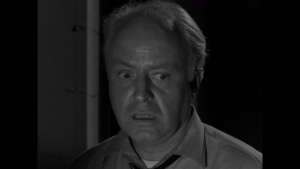
A lovely party on a beautiful suburban street. It’s Dr. Bill Stockton’s birthday, and a few of his closest neighbors and friends came to celebrate him–an idea orchestrated by his wife, Grace and son, Paulie. But, the laughs quickly turn to concerns when the voice on the Conelrad station warns everyone that unidentified flying objects have been sighted in the area. No, not flying saucers and little green men. Rather, these are potentially devastating nuclear missiles. Everyone scatters back to their homes, and the good doctor, prepared for this very event, sets up his family in his bomb shelter. But, one by one, those same neighbors and friends, the very ones who laughed at Bill for building this shelter, come back to see if they can bring their families into this suddenly necessary space. But, this is impossible. It has been built for exactly three people, and it cannot fit anymore. And as Bill closes the door of his shelter, he, perhaps, closes the door on his friends as well. Emotions begin to run hot; hurtful words and accusations begin to fly–”you’re a doctor!” Marty exclaims. “You’re supposed to help people!” The bombs are getting closer. In a last ditch effort, the neighbors grab a steel pipe from a yard and begin to repeatedly ram it into the door. All Bill, Grace, and Paulie can do is hope that the door holds. But it doesn’t. As the neighbors come pouring through the now compromised shelter, a voice on the radio once again can be heard: “we have ascertained that the flying objects are satellites.” Everyone is safe. As Bill emerges from his shelter, with the realization that, these people, these friends, might have just sentenced him and his family to a horrible death, he can only ponder if anyone has really survived this ordeal, including himself.
Episode Details
“The Shelter” is directed by Lamont Johnson. The teleplay is by Rod Serling. As for our cast, grab a beverage of choice, we’ve got a bit of a list. Bill Stockton is played by Larry Gates; Peggy Stewart is his wife, Grace Stockton; son Paulie is played by Michael Burns. Jack Albertson plays good friend Jerry Harlowe, and he is accompanied by his wife who is played by Jo Helton. Marty Weiss is played by Joseph Bernard, and Mrs. Weiss is portrayed by Moria Turner. The temperamental Hendersons are played by Sandy Kenyon and Mary Gregory respectively. The episode first aired on September 29th, 1961.
Episode Tidbits
As for our tidbits, Martin Grams Jr.’s Unlocking the Door has quite a lot. I’m just going to focus on a quotation from one of the actors, Larry Gates, who plays Dr. Bill Stockton. He states, “It was a first-rate script by Rod Serling….My character…believed he was doing the most reasonable thing with his shelter, but it turned out he had hopelessly misjudged the results of his actions. We had a wonderful cast and an excellent director, a happy company and crew and a fascinating script. When I saw the episode years later, I didn’t like my performance. I thought I had overacted. But the script, direction and cast made it work” (422). I thought Gates did a fine job acting, especially in some of the more heated scenes, like his one-on-one with Jerry and some of his deliveries with Grace in the shelter. Over and over again, actors have largely said that they enjoyed their time on the set and working with Serling and the crew on the Twilight Zone. I have to imagine, that’s actually quite a lovely compliment to receive in the entertainment industry.
Question 1: Would the Stocktons, meaning the good Dr.; his wife; and son, Paul have survived the nuclear blast?
On the surface, this might seem like a bit of no-brainer. Joe, you don’t need a degree in thermonuclear engineering to see that this shelter, which was essentially broken into by a couple of angry neighbors with a pipe, would not have survived a nuclear blast. Okay, okay…maybe. But, even if that’s the case, we don’t really know how close they are to surviving, and who knows? Maybe there is some nuclear meat on this bone. Mmmm…nothing like a good brisket flash fried in nuclear fission. So, we’re going to get a bit scientific in here, or at least as scientific as a neanderthal like me can get. And that means, I’m going to need some help. You know what I need. The Staff of Truth!
All right, let’s set some parameters and goals here. For my thermonuclear physicists out there, you’re going to have to give me some grace here. I have no doubt that there are a whole bunch of nuances and variables to this discussion, but given the time that I have, the best that I can really hope for is a somewhat competent take given what information I have available and what goals we establish. Here are those goals. 1. let’s try and better understand the math and potential destruction of a 1961 nuclear warhead. Goal 2: Let’s try and get a sense of the materials and plans they had access to in 1961. There’s no point in comparing the Stockton’s bomb shelter with the Jones’s shelter in 2026, complete with two big-screen tvs and a margarita machine. And our final goal, goal 3: Let’s try and get a sense of their potential survival odds, when we consider their post-blast environment. Okay, this is going to be a thick one my friends. But, as the old saying goes: how do you eat an elephant? One bite at a time. Although, why are we eating elephants? A cow certainly seems big enough…nevermind. I’m getting off track already.
Goal 1: In terms of the math, again, I’m going to keep this to what we knew or thought we knew back in the 1960s. In my research, the term I came across the most was factor. Specifically, the United States government, at the time, recommended that shelters be able to withstand a radiation level of factor 100. But, what the heck does that even mean? Luckily, I found a department of Administration building codes document from 1983 that gives a really clear definition.
"Protection factor" means a factor used to express the relation between the amount of fallout gamma radiation that would be received by an unprotected person and the amount that would be received by one in a shelter. For example, an occupant of a shelter with a PF of 40 would be exposed to a dose rate 1/40 (or 2-1/2 percent) of the rate to which he would be exposed if his location were unprotected (205).
Okay, so in 1961, they believed that people should aim for only being exposed to roughly 1/100 or 1% gamma radiation in comparison to someone without a shelter. Now, in our episode, the crux of the issue is, of course, that only one family on the block actually has a shelter, which causes this big kerfuffle, but was this actually the case in the 1960s? Well, it was certainly an important question at the time for the US Government and one worth briefly exploring here.
In a document prepared for the Office of Civil and Defense Mobilization, first published on November 18th, 1960 and then updated on April 7th, 1961, the authors attempt to figure out how many homes would have sufficient space for a bomb shelter, and they add the following: “Houses built before World War II are much more likely to have basements” (4). You’ll recall that Bill says to Jerry when he shows up at the door, “you better get on home and get in your shelter…” He then corrects himself and says, “into your basement.” To which Jerry replies, “Bill, we don’t have any cellar, remember? The advantages of modern architecture. We’ve got the only brand new house on the block.” This is one of those fantastic little moments in the episode that ties in quite well with actual history and with real problems of the times. People were upgrading and building homes based upon the best of times and situations, and the government now had to deal with the very problem of the momentum of progress, ie homes with no basement. But, would this really matter? You have a basement; you don’t have a basement. Jerry and the family are probably still fine, right? Right? Well….
Let’s talk bombs for a moment. In our episode, Grace says that “New York is only 40 miles away. And New York is gonna’ get it; we know that.” Let’s take her at her word and use this for our example. Let’s say that the atomic bomb goes off 40 miles away from them. Is that close, far away? How does that number relate to what the Soviets had in their arsenal? And on that note, I’d like to introduce you to the Tsar bomb, the largest, at least that I found in my research, atomic weapon ever detonated. It was tested on Severny Island in the Arctic Circle. And according to the National World War II museum site, this bomb was “over 1570 times more powerful…than the combined two bombs dropped on Hiroshima and Nagasaki” (link). The mushroom cloud alone was “25 miles wide at its base and almost 60 miles wide at its top….Everything within three dozen miles of the impact was vaporized” (link). Umm…I might be starting to understand Grace’s worries here. Now, does that mean our beloved Stockton’s are gonners? No, not necessarily. They’re just outside the initial blast zone and underground. All right, so the Stocktons are still in it, at least in terms of the distance from the blast. And that, believe it or not, is a big factor here. But, now we have to deal with the fallout problem. They also might have been helped by our friend physics. It turns out that the height of the detonation during the test actually ended up making the fallout not as bad. Quote: “the accompanying five-mile-wide fireball was repelled away from the surface by the force of its own shockwave…,thus greatly reducing the amount of fallout” (link). Now, that doesn’t mean that there is no fallout–it just means there are some mitigating factors here. And mitigation is the key word: it’s time to talk about materials and ways of keeping that nasty fallout out of our shelter.
Of course, it is impossible to 100% know for sure what materials Bill used to build his shelter, but we can get a sense if we use the family fallout shelter guides from the Civil Defense department, like the one I have here in my hands, and a little bit of observational powers. Now, you’ll recall that the name of this game is protection factor and building up enough layers to be able to achieve at least a PF of 100. But, we do have a new term to introduce here: half value thickness or HVT. The half-value thickness is a way of measuring how much gamma radiation can be attenuated or mitigated per inch of a material, at least that’s how I’m understanding the source material from the Civil Defense Association (link). And we do have some good news here as well. Bill is in a basement, which means there is already a layer of soil all around it, with the exception, perhaps, of the top. However, for roughly every 4-4.8 inches, you get one half-value thickness, which equates to a 2 Protection Factor, but it multiplies exponentially because you’re doubling the mitigation of the gamma rays with each half-value thickness you add.
Let’s just use 4” because it’s easier math. 4” of soil gives you a PF of 2; 8” gives you a PF of 4; 12” gives you a PF of not 6, but 8 because you’re doubling the 4; and 16” of soil would give you a PF of 16…and so on. And that means you would only need roughly 28” of soil to go beyond the recommended PF of 100. And remember, the PF factor is accumulative, which means you don’t need for the PF to come from just one place. There is a foundation after the soil; some kind of wall, either gypsum or plaster; and then there are the structural cement blocks that create the shelter, and even their door provides some PF protection as well. When you combine all of this together, it does seem reasonable that Bill’s shelter reaches the PF mark of 100. So, we’re doing okay when it comes to the fallout. That just leaves one last thing to discuss.
They’ve survived the blast, the initial fallout dispersion, but what about when things settle? How long are they in there for and when can they come out? Well, we’ve got some information here as well. According to an article on Middle Tennessee State’s emergency planning site, “Fallout radiation loses its intensity fairly rapidly. In time, you will be able to leave the fallout shelter. Radioactive fallout poses the greatest threat to people during the first two weeks, by which time it has declined to about 1% of its initial radiation level” (link). At that point, you can make short, only necessary trips to the surface. You’ll recall Bill tells Grace, “We’ve got enough food and water to last us two weeks.” And he adds, maybe even more if we’re careful. So, my man Bill’s got this. In terms of the air quality, he tells Jerry, “That’s a 10x10 room with an air filter designed for three people.” So, it stands to reason that he has figured out the math to be able to get clean air in and manage the carbon dioxide build up. So, where does this leave us?
Ladies and gentleman, I’m going to just come out and say it: I think the Stocktons actually had a good chance of surviving based upon what we knew then, and even a little bit of what we know now, although the recommended PF has been updated since 1961 to be 1000 instead of 100. But, I’ll go even a step further and say that it might have been possible to survive even with the busted door, provided they could put something else in front of it to, again, increase the PF. See, don’t you feel better knowing that the Stocktons could have actually survived this? I mean they’re going to need some new friends and they’ll likely need some weapons to fight off the giant radioactive cockroaches on the surface, but we can figure out those odds on another day. Question 2: Do you think things will go back to the way they were before this event ever took place?
This is going to be somewhat of a quick answer my friends. I spent a lot of time on that first question, and I actually do want to hold myself to the 30 minute limit for each episode, but that doesn’t mean we still can’t really dive into this one. So, at the end of the episode, after the announcement comes through that the unidentified flying objects are just satellites, the mood shifts from high intensity to shameful damage control. Frank is telling Marty he didn’t mean any of the terrible things he said; and Jerry does more sweeping under the rug than my Roomba, telling everyone to move on and let bygones be bygones; and finally, Marty wants to hold a block party. Meanwhile, poor Bill can only shuffle out of his shelter, realizing that these people, these friends of his, might have just killed him and his family. And then, when Jerry says “anything to get back to normal,” Bill delivers one of my favorite lines in any Twilight Zone episode: “Normal? I don’t know. I don’t know what normal is.”
Normal or normalcy is a tricky thing when it comes to humans. What is normal vs abnormal tends to be, even in good times, difficult to pin down. Here’s what I mean. Prior to this event happening: there’s a celebration going on for Bill’s birthday. We’ve got cake, laughter, and the “sloppy, sentimental speech” that Jerry gives–Bill’s words, not my own. I actually think it’s quite a lovely little speech. Is that normal? Is it normal for us to be in that mindset? To be jovial, celebratory, and so thoughtful of each other? Well, if you’ve been listening to me do this show now for a while, you’re probably thinking, Joe you’re a sloppy, sentimentalist yourself. Fair enough. But, you might be surprised to hear me say, no. I don’t think that is normal. I’m of the belief that we have to work to be kind, to be good, to recognize when others might need a bit of a boost. I think it’s probably more normal for us to be in our own heads and worried about what we need to make it through the day or even the next hour for some. And so when the neighbors start to say, let’s get back to normal and they immediately pivot to party and celebration, I can see Bill’s point. He’s suddenly realized that the happiness is not the normal. And so a return to that suddenly seems wrong. Thanks, Joe. So, life sucks and we should just accept our misery? What? No.
There’s no way around the fact that people, especially Frank, say terrible things here, things that likely won’t be forgotten. And the neighbors absolutely put Bill’s family in mortal danger with their actions–and that won’t be forgotten either. But is that normal? Is it normal for us to want to destroy each other? Well, I’m not really going to say yes to that, either. I don’t think it’s that simple. There’s selfishness involved here, and there is a yearning to survive. You might remember, Jerry, as he’s wrestling with Bill at the bottom of the stairs, he screams, “Do you think I’m going to sit by and watch my family die in agony? I’m not gonna do it!” and he grabs Bill by the arm. Is that normal? No. It’s understandable, but it’s not normal. It’s a moment within an abnormal situation. I’m not one of those people who believes that this situation brought out the real versions of everyone. To me, being human is just not that simple. But, I do understand why some people do think this is the case. Okay, so what are we left with here? Can things go back to how they were? Well, no, but maybe not for the reasons you think.
It comes back to this idea of normalcy. If normalcy is not the partying; and normalcy is not the pure unadulterated rage of survival, then what is it? It’s the creation of social space, space for us to be human, to experience not just the extremes of joy and hatred, but happiness, sadness, and my favorite of all contentment, glorious, glorious contentment, a word that we simply don’t use enough today. The reason why they probably won’t return to normalcy is not because of all the terrible things that happened but because they realize that living within the opposite, the pure joy is also not really normal and sustainable. Partying all the time and wanting to just be in a state of bliss masks the fact that to be human is to constantly be in a state of work, trying to make things better for not just ourselves but for others as well. And you can’t see that if you’re always living la vida loca and partying like it’s 1999–or 1961, or 2026. And so, no, things won’t go back to the way it was because the proverbial veils have been lifted. The people involved here will probably find a way back to a more balanced version of life and that’s not really such a bad thing.
Question 3: What are your moments of awe?
My moment of awe has to do with the feeling we’re left with at the end of this. This episode has always frightened me and it still does. Part of the reason is because it’s masterfully put together in terms of the development of suspense and the rise of conflict, all of which seems incredibly natural. But, another reason for this is because of one particular scene. As the neighbors are bashing down the door, the camera cuts to individual closeups of BIll, Grace, and then Paul. And you realize something: there is hardly a thing that they can do. They are trapped and the looks on their faces indicate that something quite primal has happened to them: they have been reverted back to a moment where they are merely the prey of some more aggressive animal. What I mean by this is that I take the neighbors here and lump them together not as individuals but as one large monster. It’s horrifying. We create all manner of monsters that hunt us in movies: you think of Ray Harryhousans masterpiece monsters from Clash of the Titans or you think of H.R. Giger’s alien design, and of course these are frightening figures. But, I’m not sure there is anything more frightening, really, than us, than the human being in a state of willful destruction. And a big part of this is likely because we are human ourselves and know just how terrible we can be. But, all is not lost. We also know how good the human being can be, and we can band together and push back against the monsters of the world. And that should leave you with at least a sense of hope.
My Rating.
As for my rating, this is Top Top-Tier for me–and so, it’s getting the coveted ringing of the Twilight Zone Tower of Terror Bell. This is easily in my personal top 5 episodes, and it is one that really stays with my students after they’ve watched it. The acting is amazing; the gradual growth of intensity from when they start banging on the shelter door just makes your heart pound in your chest. It’s an amazing episode.
Next Episode
Next time,we’ll be taking a look at the Twilight Zone episode “The Passersby” and here are your questions to consider when watching the episode:
Question 1: How do the arts and humanities in this episode amplify its message?
Question 2: Is there something more profound about this road concept than we might initially think?
Question 3: What are your moments of awe?
Announcements and Shout-outs
Quick announcement. Serlingfest is coming up in about a month. It runs from Friday August 21st through Saturday the 22nd, and it usually includes a small event on the Sunday as well at Recreation Park where the Rod Serling Statue resides. It’s really quite a fun little intimate event. I’ll be there at minimum for Saturday this year. It’s actually still a bit up in the air if I can be there for the Friday night festivities, but I’ll do my best. As we get closer, I’ll start to set up some additional coordination efforts. However, if you see me in the wild over there, you certainly need not be afraid to just walk over and say hi.
I’ve got a short comment that I would like to highlight from the YouTube channel. @Kevin-h5x9zWrites the following on my “The Howling Man” episode. Wait, I should be holding my Staff of Truth for this. “I just read the story which is a lot more ambiguous.” Kevin, you inspired me to go back and reread the story, which I actually did. I had forgotten how different it is from the episode in some respects. I won’t spoil it here for others, but if you love the episode as much as I, and Kevin, do, it’s worth a read. You get quite a different picture of our protagonist and a somewhat different outcome. It’s light reading so it’s perfect for when you just want something that is easy to finish in one sitting. Appreciate the time, Kevin.
How to Support the Show
Want to support the channel? Consider subscribing, liking, commenting, and sharing the show with a friend–you know all of the usual algorithmic gymnastics, that will help us expand our awesome community of Twilight Zone fans. Plus, you never know, I might just highlight your comment in an episode of the show–as long as it's family friendly. And if you want to be immortalized on our list of key KOI supporters, consider joining one of our membership tiers on YouTube or Patreon. I’ve got additional content videos that analyze Twilight Zone episodes from the 1980s, the early 2000s series, and the Jordan Peele 2019 series. Additionally, 50% of all money taken through this channel, after the platform fees, is going to charity. 25% to the Rod Serling Memorial Foundation, and 25% to the Gary Sinise foundation. For more information about me, my scholarship, and the show, head over to the keyofimagination.com. That being said, even if you hated every minute of this, I’m still going to thank you for spending some time with me. Until next time, remember, all doors are open to those who possess the key of imagination.
Works Cited and/or Consulted
Martin Grams. The Twilight Zone : Unlocking the Door to a Television Classic. OTR Publishing,
2008.
Zicree, Marc Scott. The Twilight Zone Companion. Second edition, First Silman-James Press
edition., Silman-James Press, 1992.