
The Twilight Zone Season 2: Episode 50
"The Whole Truth" Episode Transcript
Introduction
Welcome to the Key of Imagination. This week we’re going to be looking at the Twilight Zone episode “The Whole Truth.” We’ll talk about whether or not there’s a particular slant to the kind of truth that this car expects of its owners; we’ll attempt to analyze what Serling is really trying to say through this episode about truth; and I’ll reveal my moment of awe, a look inside the truth behind mirror therapy. So, grab your keys and let’s open up this door to the fifth dimension.
Plot Summary
Harvey Hunnicut is a man of integrity and honesty. He’s not simply selling you a car; he’s providing a service…a means of transportation far greater than any road or street can take you. If you just want a car that will take you from point A to point B, well, then by all means, go to some other dealership. But, if you want to purchase a life experience, the kind of adventure that can only come from owning a vehicle that requires a little more attention and care, then you’ve come to the right place, my friend. And if all that sounds good to you, then you’ve probably bought a vehicle from a man like Harvey Hunnicut before. But, on this day, Harvey is the one who will be…taken for a ride, when he purchases a car that requires its owner to tell the truth–the whole truth. No longer able to present his usual prevarications, Harvey finds himself unable to sell a single car on his lot–until another fine gentleman of the highest integrity visits Harvey’s establishment, a politician by the name of Honest Luther . And although Mr. Grimbley decides to…pass on purchasing the vehicle due to the occupational hazard it would create for his line of business, he does offer a suggestion for the next owner of this special vehicle, a man by the name of Nikita Khrushchev, yes, that Nikita Khrushchev, as in the Prime Minister of the Soviet Union. A signature on a piece of paper is all it takes for the car to become someone else’s problem now. And good old Harvey Honicutt can finally get back to making an honest living.
Episode Details
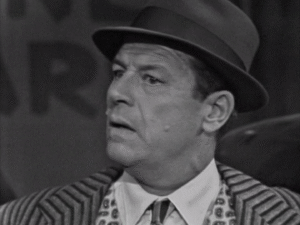
“The Whole Truth” is directed by James Sheldon. The teleplay is by Rod Serling. As for our cast, let’s start with our man Harvey Hunnicutt, played by Jack Carson; George Chandler is the gentleman who sells the car to Harvey; Arte Johnson is our very interesting young salesman; and Loring Smith plays Honest Luther Grimsley. The episode first aired on January 20th, 1961.
Episode Tidbits
Okay, for our tidbit, I have a bit of a Twilight Zone in real life connection here. As I watched this episode, it actually brought me back to the “Mr. Bevis” episode, mostly because of the car connection, which is hardly a connection at all, but also because that episode seems to falter a bit in the same fashion for me as this one does. Between the two, I prefer “Mr. Bevis.” But, I remember thinking: “why the heck does my mind keep connecting this to the Bevis episode?” Then, I read in Martin Grams Jr.’s book the following: “The idea for this script originated from two unused plot synopses composed by Serling for the previously proposed Mr. Bevis television series” (359). Apparently, one of the blessings that Bevis was going to receive was the gift of having to tell the truth for 24 hours. What’s odd about that is I don’t see the Bevis character as a liar, so I’m not sure how that would have worked out–probably not well. So, it isn’t exactly getting wished into the cornfield or falling out of bed and into a parallel dimension, but an odd little Twilight Zone moment, nonetheless. Additionally, this is one of our six video taped episode, and no, it’s not the one that I keep saying actually benefits slightly from this different medium, although we’re getting pretty close to you being able to get it by process of elimination.
Question 1: Is there a particular slant to the kind of truth that must be told when it comes to the car?
Let’s begin this question with a famous poem, a favorite of mine, and right in my early American wheelhouse.
Tell all the truth but tell it slant —
Success in Circuit lies
Too bright for our infirm Delight
The Truth's superb surprise
As Lightning to the Children eased
With explanation kind
The Truth must dazzle gradually
Or every man be blind —
That’s poem number 1263 by the great American poet Emily Dickinson. So, what does it mean? Let’s start with the first line, which often stands in as the title of her poems, “Tell all the truth but tell it slant.” Often times when we talk of truth, especially today, we speak of it in the same vein as facts, as in, there is only one truth and it is scientific, but that’s not actually the case. Truth is actually much more complex than that. Two people can see the same event, describe it very differently, and yet both will swear they are telling the truth, and you know what: they actually might be. You see there is a part of the truth that lies in relation with one’s perception of reality. And so when Dickinson says, “Tell all the truth but tell it slant,” one way that we can think about this proclamation is to say, speak your perception as accurately as you perceive it, and do so with the understanding that you have a unique vision of the world.”
[Oh dear Lord! They’ve captured Joe. We’ve lost him to the gobbeldy gook world of English majors.] Well…yes, and no…hard maybe at the worst. Let me explain a little more because this is going to be important for our Twilight Zone episode and our question. Toward the end of Dickinson’s poem, the last two verses specifically, she says, “The Truth must dazzle gradually / Or every man be blind–” Okay, in this section she speaks of truth in a more global sense about men becoming blinded by it. [So, wait, I thought you said Truth was about individual perceptions?] Yes and no. Here’s the trick: the more we talk, the more we dialogue about what we collectively see as our perceptions of reality, the more we can begin to develop a collective vision of the truth. That’s one of the reasons why we form groups and parties and all manner of assemblings together. Truth is not facts, although facts are important components of the truth of something. The reason why Dickinson says that truth must dazzle gradually is because we can’t live by epiphanies, or sudden bursts of revelations. Epiphanies serve, I believe, an important function: they help us quickly realize when we need to know something, need to come to a conclusion about something that is potentially dangerous. Think about it. How often have you had a friend suddenly say something like, I just realized I’m being manipulated. That’s an epiphany, and epiphanies require immediate acknowledgement and action. Whereas, coming to the Truth about something, allows for a gradual understanding of how your mind came to its conclusions. Truth has much more of a staying power than epiphanies. So, what do I want you to take away from this preamble: Truth is not facts; it is about conclusions drawn by one’s actual perceptions of a reality. Truth is valuable when you or we as a collective are accurately conveying that perception with integrity. Okay, hold on to that! Now, how does this connect with our episode?
When the gentleman sells the car to Honeycutt, and the ink is dry on the page, the gentleman says as he’s leaving, “I think you may find that you have actually gotten the best of the bargain at that.” To this, Honeycutt responds: “My ancient friend, you do me an ultimate injustice. Our little transaction, haunted or otherwise, was my charity case for the day.” Now, the car is sold, so it’s fair for us to consider this exchange in two ways: first, either the car permits perceptions of truth–ie, telling the truth with a slant; or what he’s saying here is the whole truth. As in, Honnicutt did this as part of a good deed, which means he’s really not that bad of a guy. As all the cool kids say today, I think we’re starting to cook here.
When Honeycutt comes back out to speak with the young couple, he starts to freak them out a bit because he suddenly says that the car isn’t for sale anymore. But, is that the truth? I don’t think that this is accurate. What if they just wanted to buy a car to smash it into a tree? Would the car NOT be for sale then? So what is actually going on here? Let’s start to land this plane. It’s not about lying; it’s about the car not allowing for the misperception of the Truth! When the couple asks why it isn’t for sale, Honeycutt begins to do what? He starts to go over tangible items: the engine, the tires, and normally he’s able to mischaracterize the perception of these things. The tires are in great condition; the engine can run forever. But, that’s not his actual perception of these items. Instead, because of the car, he now says the engine eats gasoline and the tires are very bad.
Let me give you another example. Honeycutt’s employee comes in and immediately gets reprimanded. What did he do wrong? Honeycutt tells him to STOP leaving the engine doors open on the cars. That’s why he closes the hood when he first sees the young couple. The purpose is that he wants to alter the perceptions of reality. If they can’t see the old, oil-dripping engines, they can’t incorporate it into their perceptions of truth. And that’s how people are able to manipulate truth so easily. It’s not about lies, per se; it’s about what perceptions of reality you can create around individuals so that they come to the lie on their own–it’s quite dastardly. In some ways, Honeycutt is an absolute master at manipulating realities, which allows him to control the truth within his world, ie., the car lot. You have to be careful out there–all of us. Often times we think we have the truth when all the while we might be missing something that someone is leaving out of our perceptions of reality. So, is there a kind of slant to the truth in this episode? Absolutely, one that would make even Emily Dickinson herself blush.
Question 2: What is Serling’s overall point here with this episode?
Okay, gather around, everyone. It’s time for another story with Uncle Joey. When I was 19 years old, a Gateway Computer store opened up not that far away from where I lived. It was shiny and new, and my job that I had been working at for a few years was old and easy, so I decided that I was going to jump into the magical world of computer sales. Mind you, this was back in 1999 when people still had to dial in to connect to the World Wide Web and single-threaded processors still roamed the earth, but all of that was about to change and I wanted to be a part of it. So, I went for the job, got it, did the training, and hit the salesfloor. Now, I loved computers, and I was even pursuing my first college degree in computer science at the time, so I had quite a bit of knowledge about them. Now, at the time, I was working part time, around 20 hours a week; however, not only was I the top part-time salesman, but my sales were greater than three of the five full-time salespeople–yup, no joke. I was good at my job, and why was I good? I listened to my customers and told the truth. If they said that all they wanted to do was surf the web, do email, and type a few documents, I sold them a perfectly reasonable machine. I never upsold. And because I was honest, I also never had people return computers. Now, on one occasion, a particular customer aggressively pushed me to upsell her to like a $1300 purchase, even though I told her she didn’t need all of that. Not only did she insist, but she essentially accused me of not listening to her. I finally said, it’s fine with me. It’s a great computer; you’ll enjoy it. Sure enough, she came back in a couple of days, spoke with my boss, and accused me of overselling her. My boss called me into the office with the customer and with one of my assistant managers who was there and witnessed me doing my best to help this customer, and you know what happened: the boss reamed me out in front of everyone. Now, I refused to apologize because I didn’t do anything wrong, and I told my boss, we need to talk alone. I promptly informed her that she just lost her third highest salesperson. I gave my two weeks notice and returned to my previous job. Great story, Joe. What’s the point?
My point is this. Good sales is about listening to people’s needs and then assessing what you believe will be the most valuable truth to the customer. Now, you might think that sounds naive, but actually it’s not. What it is is accurate. You see, that idea of finding the most valuable truth within a customer works both ways. In my case, I used it as a mark of my integrity. I wanted the customers to enjoy their computers, and so the truth that I targeted was maximizing their enjoyment of use. Honeycutt, believe it or not, actually does the same thing. The difference is he targets the truth of their fears. For example, when Honeycutt talks to the young couple, and the young man mentions that he wants the latest model that $500 can buy, Honeycutt immediately preys upon the young man’s fear of looking foolish in front of his significant other. It’s also why Honeycutt takes the young man aside, to give the woman the impression that her significant other is taking control of this situation and can redeem his terrible choice of looking for a late model. Now, let me tell you something: for anyone who has been in sales, they will tell you that this absolutely works on a large swath of the public. So, that’s a lot of set up, but let’s use this information now to hyperfocus on our question.
Serling introduces two characters here of significance, both of whom are politicians. The first one is the American politician who is savvy enough to get to Honeycutt’s truth. And how does he do that, by turning the tables and acting a bit like a salesman himself, which is another pejorative at times for politicians. And how does the American politician figure out that Honeycutt is telling the truth, by cleverly placing him in a situation where he should lie. He asks Honeycutt about another car on the lot, and Honeycutt talks about how terrible of a condition the car is in. At first, the American politician wants to simply assess Honeycutt’s relationship to the truth, just like I did with my computer customers, and what Grimsley finds out is that the truth is completely tied to Honeycutt’s integrity, and that’s when Grimsley realizes that he can let his guard down and actually be honest. He says, “Buddy boy, I’m in politics. When you tell me that I gotta’ start tellin’ the truth all the time, Holy Hannah…you know something. I couldn’t make a single political speech.” Serling’s point here, of course, seems to be that built within the political structure is the belief by politicians that lying is embedded within speech. But, of course, honest Luther Grimly isn’t the only politician in this episode. We also have Nikita Khrushchev, the former Prime Minister of the former Soviet Union. Why is Khrushchev here?
There is a surface-level reading of this episode, that being the somewhat funny one. A regular American is able to singlehandedly win the cold war against the Soviets by tricking Khrushchev into buying a car that forces him to tell the truth to his people, and thus, as old Honest Luther Grimsly mentions, ruins the Soviet Prime Minister’s ability to give speeches of propaganda to his people. In other words, he can no longer find the truth that his people yearn to hear and use it to manipulate them. In that sense, this episode is quite a victory lap for Americans, the likes of which we won’t see again until a man named Rocky Balboa defeats the super russian boxer Ivan Drago in a boxing match in 1985. USA USA USA!
But, wait! As I said, that’s the surface-level reading. There is a more nuanced reading of this episode that doesn’t quite make us look so good, and I do think that Serling is a good enough writer to have had this in mind when he wrote the teleplay. In this episode, you can say we defeated the Soviets with the truth, but not because we valued the truth; it’s because we weaponized it. In doing so, we’re essentially telling our own people that the truth is damaging; the truth will bring nations to their knees; the truth is not something that the people of the United States need be bothered by. USA USA USA!
So what is Serling’s point here? The truth is every bit the weapon that we believe it is, and weapons can be used to free people and destroy them. I think a question that Serling might have for us at the end of the episode is if politicians started telling the truth, the whole truth, and nothing but the truth to us Americans as citizens of this great country, would it free us or destroy us? I don’t always know the answer to that myself, but I would like to believe that we could handle it and come out a stronger nation for it. And that’s the God’s honest truth.
Question 3: What are your moments of awe?
My moment of awe this week is a bit of an extension of our first question. As I was editing my transcript, I suddenly remembered an awesome video that I watched years ago from Temple University. It was about a concept known as mirror therapy. I’ll try and remember to leave a link in the episode details section, but if I forget it will be in the episode transcript on the keyofimagination website (link). We have a concept in life known as proprioception. In the previously mentioned video, they define this term as “This is the brain’s ability to sense where your limbs are even when you can’t see them” What mirror therapy attempts to do is help people who are suffering from what we might call phantom pain in either limbs that are no longer there or limbs that have been severely damaged. You place one limb in front of the mirror and the limb that is experiencing the pain on the back side of the mirror so that you can no longer see it. Now, while staring at the reflection, you begin to tell your brain to move the missing or affected limb while simultaneously doing the actual movement with the limb that you have full function over. For those of you on audio only, I’m probably not explaining that the best as possible. In short, you’re tricking your brain into perceiving that you are moving the limb that is either missing or in great pain. By doing so, you are essentially altering what is true by altering the person’s perceptions of reality. Is it true that the limb is there or that it’s moving at the speed it appears to be in the reflection? No. But, that’s actually the point; you’re creating truth in relation to perceptions of reality. More than anything, I don’t want you to think that I’m saying that truth does not have value; it has incredibly important value. What I think we struggle with as a species, however, is HOW to value truth and place it into the proper context of personal and collective social meaning.
My Rating
As for my rating, ugh…I hate to do this to you Serling…but I’m going to have to give this one the dreaded Lower Upper-tier. I don’t think it actually does successfully flesh out its premise, not really. It’s not that it doesn’t have a plot; it clearly does. It’s that much of the episode clearly seems to be moving toward accomplishing the one main joke in this episode: that being Khrushchev having to tell the truth to the Soviet people. Now, we’ve talked about how the Cold War was an incredibly big deal in episodes like “Third from the Sun,” but this one makes a bit too light of it for me. So, it’s a lower-tier episode for me.
Next Episode
Next time, we’ll be taking a look at “The Invaders” and here are your questions to consider when watching the episode:
Question 1: How potentially truthful is this narrative for us as explorers?
Question 2: Is this woman a hero?
Question 3: What are your moments of awe?
Announcements and Shout-outs
Exciting quick announcement, we’ve got some extra content ready to go through both YouTube memberships and Patreon memberships for those of you who would like to help support the channel and raise some money for charity. I’ve got an extra content review of the 2019 Jordan Peele episode “The Comedian” ready and a bonus review of the 1980s Twilight Zone series episode “Nightcrawlers.” In both, of these reviews, I get a bit more critical than usual, but I believe I’m fair in my criticisms. I guess you’ll just have to let me know.
I do have some comments that I would like to highlight from the YouTube channel.
On my “Walking Distance” episode, SkepticalZack writes, “12:50 this is my major malfunction. I had to give up humanism because as it turns out you have to love humans for that. Unfortunately the more I learn the further from that I become.” First, thanks for taking the time to leave your thoughts. I genuinely appreciate it. There is something to your point here. I think oftentimes the more we read about humanity, the more we can begin to sour on the point of it. We have absolutely done some horrid things in our time on this planet, but you can’t throw in the towel. The truth is that we need as many people as possible continuing the fight for good, the struggle to keep at least one eye trained to see the good in humanity. This is how we maintain our hope. I hope you can retain some of that yourself, Zack.
Now, on my “Dust” episode both Elmermedina and Juanguerrero had pretty much the same thought: @juanguerrero1468 writes. “I have a special fondness for this episode and season 3 The gift. They have a place in my heart.” And @elmermedina1713 also wrote, “I have a fondness for this episode” I’m glad that I’m not the only one who has a fondness for this episode, although like many others mentioned, it’s quite a difficult one to wrestle with in terms of ethics, justice vs vengeance, etc. No amazing commentary here; I just thought it was cool that they both used the word fondness. I can be a simple man like that sometimes.
How to Support the Show
If you enjoyed the show and want to support our mission, get extra content, and give money to not one but two great charities all in one? Consider joining one of our membership tiers on YouTube or on Patreon. 50% of every dollar taken through this show, after the platform fees, is going to charity: 25% to the Rod Serling Memorial Foundation and 25% to the Gary Sinise Foundation. That means every gift, superchat, thank you, and membership will help us get closer to our goal of leaving a legacy of giving that Rod Serling himself would be proud of. [Roll the list of supporters]. Plus, we’re preserving a way of life for future fans of Serling’s work, especially the Twilight Zone. To learn more about me, our mission, why we’re doing it, and how you can help, head to thekeyofiagination.com. Keep in mind, If you watch, like, comment, thumbs up, subscribe, and share the show with a friend, you’re also doing your part to support this mission and I’m grateful for it. That being said, even if you hated every minute of this, I’m still going to thank you for spending some time with me. Until next time, remember, all doors are open to those who possess the key of imagination.