
The Twilight Zone Season 1: Episode 8
"Time Enough at Last"
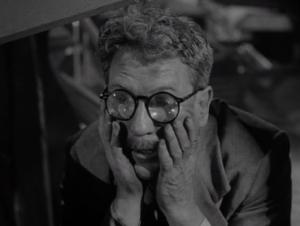
As I sit and record this episode, in the back of my mind are all of the tasks and deadlines that are piled upon my insufficient brain and body. I have papers to grade, lessons to create, publications to write, things to fix around the house, and amidst all of that, I still have to find some time to be human–to appreciate my marriage, my loved ones, my students, and all of you out there who are spending some of your precious time to be with me. Stop and smell the roses–they say. But, what if I don’t want to smell roses? What if I just want a moment to sit with my own thoughts, undisturbed? As the Bard would say, “perchance to dream.” The world today is filled with all manners of communication–all vying for our attention. And although technology has undoubtedly added more vehicles for communication, we seem to say much less. More than I can remember, I find that it is important for my own health that I find at least a half an hour or so where I can just be with my own thoughts–to make sense of the clutter and chaos and prepare for the day. With that in mind, let me introduce someone who is probably at least somewhat known to us all: Mr. Henry Bemis, a man who wants nothing more than some time to read: poetry, the news, even political buttons, anything that he can get his eyes on. And although I do not recommend people locking themselves away in bank vaults, there are times when I understand the sentiment. But, when a cataclysmic explosion wipes out humanity, and Mr. Bemis finally finds that moment to himself, his thoughts are drowned out by the deafening sounds of silence. At the height of his desperation, when all purpose and hope have left Mr. Bemis, a chance look upon a pile of rubble that used to be a library provides all that he needs to push onward in life. As the title of the story states, there is Time enough at last.” But, just like the Devil, time can be captured but not held for very long. Whereas one glance brought salvation; another brings ruin. As Mr. Bemis looks down to pick up a book, his glasses fall to the earth and join their place with the rest of the world, as little more than broken remains of a broken species. Mr. Bemis is left to wander–sightless, alone, and with exactly what he always wanted: time.
“Time Enough at Last” is directed by John Brahm. The teleplay is by Rod Serling based on the short story of the same name by Lynn Venable. It originally aired date on November 20, 1959.
Our cast stars Jacqueline DeWit as Helen Bemis, Vaughn Taylor as Mr. Carswille– we’ll see Vaughn Taylor again in the fifth dimension. But, our main character, Henry Bemis, is played by the great Burgess Meredith. This is the first of four appearances by Merdith–and it’s arguably the most well known of the four, although it is not my personal favorite. But, that’s a conversation for another time. Meredith had quite a wonderful career, playing some incredibly memorable characters like, “The Penguin” in the Adam West Batman, but he is etched into my mind as the loveable Mickey from the Rocky franchise. I’ll leave it at that for now because we’ll have future examples to discuss Mr. Meredith.
As for episode tidbits, there is no doubt that Serling and Meredith believed in each other’s work. In Martin Grams’ Jrs’s Unlocking the Door, he includes a wonderful little note that Serling wrote to Meredith dated September 10, 1959: “You did a superb job fo rus and from the rough cut, I’d say that this is one of our most effective shows. Thanks and bless you and should you ever need a writer as a kind of a personal side man, may I volunteer” (200). Having Rod Serling as your personal writer would be quite wonderful. I could certainly use him for some of these rough openings.
In The Twilight Zone companion, Zicree includes a comment that Serling made about working with Meredith: “It is so easy. He understands immediately. You respect him. Actually, one can say that everything moves right, from the beginning, without much talk. Burgess Meredith is in a class by himself” (68-9).
This might sound ridiculous, but I have to imagine that one of, if not the greatest, compliment you can pay an actor of any era is that they were easy to work with. The actors are there to produce a vision, and although I have no doubt that some actors become the vision themselves, there’s a part of me that always has a bit of a soft spot for people who dream and want to see their visions come to fruition. It sounds like Meredith respected the idea that a director has a vision and that it should be given a fair chance to be seen.
As for my initial thoughts on the episode, I mean, come on. There are certain episodes of The Twilight Zone that are almost inarguably great. This is one of those. I have had conversations with people who hate the ending, which is fine. There is definitely a part of us that feels like Bemis may have his issues but he doesn’t deserve that ending. Whether you like the ending or not, you have to admit, it’s quite a moment, to see those glasses hit the floor. Our throats just drop right into our chests. What this episode does that is truly brilliant is it exposes an important truth: life is sometimes cruel and unfair. There is no way around it. But, as I will try to argue a little later in the show, there is definitely some room for laying blame at the feet of Henry Bemis. That’s right. Buckle up, friends. We’re going there.
Let’s dive into question 1: Why do we seem so interested today in stories that involve the almost complete destruction of the species?
When “The Walking Dead” came out over a decade ago, I have to admit, I was drawn into it. I didn’t really make it past about 3-4 seasons, but I enjoyed the high-stakes storylines and the constant intensity of our intrepid characters having to fight off the undead and the still living. The people who created the show were able to tap into something that was festering within society, a deep-seeded need for purposeful existence. Every decision that was made, every action that was carried out–all of it had glorious purpose behind them. And every time the sun broke in the morning, it ushered in a new beginning, a chance to build something useful, to partake in the resurgence of the human spirit. And at night, just before our eyes gave way to sleep, the moon would provide a spotlight just for us, to give us a personal stage to give thanks for the day and to sprinkle a bit of hope for the morrow.
That’s the romantic vision that we are sold with post-apocalyptic stories. But, there is also death, famine, betrayal, all of the horrors that you can believe–and even some that you probably couldn’t believe if you tried. And…the constant dread of fear. Let’s stay here for a bit and talk about some real-life fear on an extinction level event level.
In “Time Enough at Last” Bemis reads a news article in the bank vault about the H-Bomb or hydrogen bomb and its destructive force. At the time, America was in the middle of an arms race with The Soviet Union, a cold war. And with each explosive that was added to their respective arsenals, a new level of fear was also added to their respective citizens. Although traditional war and plagues have always been around, and could always cause massive destruction to the species, these new bombs brought a whole new level of concerns for the future of mankind. If the world was going to end, it suddenly seemed likely that it was going to do so by our own hands. But, out of fear we often find strength; and out of ugliness we can find some beauty.
In 1954, just five years prior to “Time Enough at Last”, a man by the name of Shigeru Kayama–and please forgive me if I’m not pronouncing his name as it should be–Mr. Kayama was developing a character that would go on to become one of the most well known figures in cinema history–or should I say, monsters in history. The first Gojira, or Godzilla, film emerged on the big screens in 1954–and although the film differed somewhat from Kayama’s initial vision, we cannot deny the lasting impact that Kayama has had on both the giant monster genre and science fiction. The latter is the one that often gets neglected. For you see, Godzilla is a product of radioactive testing–a bringer of judgment upon us as a species. In later iterations, he will become a kind of protector of humanity, but that was not always the case. Godzilla serves as a reminder that there are consequences to our actions–and these consequences can be extinction-level-threats.
To circle back to our question, why do we yearn for these stories of destruction. I think the answer to that question is two-fold. First, like Godzilla and even the Walking Dead, there is a part of us that believes we need reminders of the fragilities and blessings that come with being human, with being alive. At any moment, these can be taken away from us, and we are left in a state of clawing and scratching to keep mankind from going extinct. There are times when we can romanticize this struggle. I’ve heard people talk about wishing that we could experience a walking dead scenario, and rather than look at them as if there is something wrong with them, I actually spent some time thinking about why someone would say something like that, which brings me to my second point about why we love returning to this genre.
do believe that there is a part of us in modern society that yearns for a kind of destruction–hear me out. Destruction in the sense that it leads to a potential rebirth and resetting of society. Believe me: I do not want this; I do not believe we should want this. But, the more our civilization becomes complex, the more I believe we will want a destructive moment, something to slow down the continuing expansion of complexities that are added to daily life.
My worry, and I desperately hope I am wrong, is that this yearning for destruction will lead us to another large-scale war. And there will be reasons thrown around by all involved for why we needed it–and many will likely seem proper in nature. But, underneath it, will be this disturbing call toward self-destruction.
How do we fight it? With empathy, care, steadfastness, camaraderie, and humanity. All of the things that Rod Serling himself tried to put into the Twilight Zone.
Coming back to our episode, Bemis is an interesting character. He originally wants nothing more than to be left alone. He quite literally closes the door on the bank vault in order to create his own world–a space from which no one else can enter. But, one of his main problems is that he doesn’t quite realize that this space also already exists internally, in his mind. He seems to shut people out of his world. He treats others like they are NPCs in a video game, characters who are only there to be interacted with on his terms. Then, when the bomb externalizes and makes manifest the solitude that he believes he wants, he finally realizes that he has taken his access to humanity for granted, something that I believe we all do at times. I’ll simply say, I know I’m guilty of it at times. And that takes us nicely into our second question.
Question 2: Undoubtedly, Bemis is a character who has our empathy–maybe even our sympathy, but should we be laying more blame on him for his difficult life and even the final outcome of the episode?
Okay, this might be an unpopular take. Feel free to wish me to the cornfield for it. But, when I rewatched this episode for the show, I realized a few things that I never really did before. If you consume the show through the video option or you see my picture on the website, you know that I wear glasses like Henry Bemis. Well, there was a time period of a couple of weeks a few months ago when my glasses had become somewhat looser over time. They began to slip down my nose more easily, and on a few occasions, fell right off of my face. I realized that I needed to get them fixed when I looked down while in the classroom and they fell right on the floor. My glasses didn’t break, but it prompted me to finally go to the vision store where I purchased them and had the technician bend them back into place.
At the 8:53 mark in the episode, Helen, Henry’s wife, starts to rip the pages out of his poetry book and throws them on the floor. Bemis bends down to pick them up and his glasses immediately fall off, foreshadowing the ending. You can probably see where I’m going with this–and maybe it’s a weak argument, but had Bemis not been so much with his head in the clouds, would he have been more likely to get his glasses adjusted so that they wouldn’t fall off so easily? Additionally, I love literature and poetry as well–enough to make it my life’s work, but those moments where Bemis was reading became his only source of happiness and escape. Should that have been a sign to him that he needs to open up his world a bit more, to look for ways to find happiness in other areas of existence?
I want to make it clear. I don’t think he deserves the ending that he gets, but is there a bit more responsibility on his end than we are initially willing to give him? I’ll be curious to hear from people about this question. You can email me your thoughts or even record them and send them to keyofimaginationshow@gmail.com. I would like to know.
Where did you find your moment of awe, something that moved you or inspired you to think beyond the surface? As many of you who are watching the video versions of these shows, I ama lover of books. As Mr. Carswill says in the episode, I am a “reada.” I love great literature and poetry. One of the poets mentioned in the episode is the great T.S. Eliot, and he has written some of my favorite works: The Wasteland, The Four Quartets, and, “The Love Song of J. Alfred Prufrock.” I’m fortunate enough to have had quite a few chances to teach “The Love Song” and we always have wonderful conversations in the classroom about the measure of a person’s life. But, there is one section of the poem that always prompts me to think. Here it is:
In a minute there is time
For decisions and revisions which a minute will reverse.
For I have known them all already, known them all:
Have known the evenings, mornings, afternoons,
I have measured out my life with coffee spoons;
It’s this last part that always gets me. Every morning, I get up and I have my cup of coffee; and when it runs out, I go buy more; and I begin the next day the same. I wonder how many spoons of coffee I have had in the past 10 years, and how many more spoons of coffee I have left. Does that sound somewhat romantic? Well, let me ruin that sentiment for a moment. If we’re not careful, we begin to believe that coffee spoons are the only way to measure our lives. We can become so entrenched in the day-to-day that we offer ourselves no time to actually be in the present moment with others, to experience something out of the ordinary and wonderful. To bring this back to our “Twilight Zone” episode: Henry Bemis probably could have used a few coffee spoons in his life, things that could anchor him to reality; however, I would be a hypocrite if I didn’t admit that, there are times when I hide in my own version of a bank vault, with a book or something, in order to avoid the world and be carried away somewhere else, to be reminded of the grandness the human experience through great works of literature. Find your balance, your coffee spoons and your bank vaults.
Okay, so, where do I rate this episode? Well, not only is this uppertier; it’s a probably a standard for uppertier episodes for many of you–and I can’t really argue too much against you. However, as I alluded to earlier, it’s a favorite, but it isn’t my favorite–-even amongst Burgess Meredith episodes. I place this episode stoutly in my upper-middle tier. There is no denying its brilliance.
Next time, we’ll be discussing: “Perchance to Dream.” Now, I’m going to issue a potential spoiler alert here for our questions. So, if you want to see the episode first, go ahead turn off this KOI episode and go watch the Twilight Zone episode. You can then come back here and get the questions. Spoiler alert: my questions this week give a way a key component of the story, so proceed with caution. Here are your questions to consider as you watch.
Question 1: Does Edward recognize Miss Thomas, the receptionist, at the beginning of the episode or not?
Question 2: Is Edward killed by his dream, or is it the heart problems that get him?
Question 3: Where do you find your moments of awe?
Another episode in the books–and a big one at that. So many different shows have spoofed “Time Enough at Last,” but I think my favorite is still the Family Guy spoof with the little brain cell. That’s a great one.
Okay, I’ve got a few key comments here that I want to acknowledge from the YouTube channel: These comments come from “The Lonely” episode:
Jackiekjono writes, “Jean Marsh was also a companion on Dr Who.”
MarkFlavin1 comments,
I really like the lens you presented here. With the epic of loneliness we are seeing it is no doubt that synthetic companions be they ai chatbot or robots will start to fill the gap. But what happens when we start to care for them and they can’t care for us. Their models may mimic feelings but gap between feeling and mimicry is essentially infinite. But more scary is when they can feel and for whatever reason your companion doesn’t like you. Can you compel feelings? Where does the line between ownership, companionship and selfhood lay?”
You’ve got a good point here, Mark, especially about compelling feelings. Let’s say we can simply program them, ie compel them, to feel for us. Would we really know how to respond to that? Would we feel like we’re being genuinely cared for? I don’t know. Your great questions are just leading to more great questions, which is absolutely perfect. I love it. Thanks, Mark.
@CSiri-cc2hq offers a different take.
We havent failed as a society, we've simply extended life beyond whats reasonable. So a "machine companion" makes so much sense as a pacemaker or an artificial heart valve.
I’m with you CSiri in the sense that if we always think of them life heart valves or pacemakers, ways to extend our abilities as a species, I think that might end up being the healthiest way for us to interact with our robot overlords. Okay, I went a bit dramatic there in the end. Thanks Csiri.
In fact, thanks you to all of you who take the time to comment and keep our conversations going. These are wonderful, and I’m already starting see a community forming. That’s exactly what I was hoping for.
A quick note: I’m a one-man show over here, so I’m writing, producing, and editing this, as well as maintaining the websites, but my primary concern as of late is really dialing in the audio for the show to get more consistency. I’ve been reading about audio engineering and practicing. Hopefully, it all starts to really fall in place soon
Head over to thekeyofimagination.com to continue our conversation. You can rate this episode, learn more about me, watch previous episodes of the show, and check out my curios page where I showcase some of the Twilight Zone trinkets I’ve bought over the years. I encourage people to email me thoughts and comments, whether it’s about a particular Twilight Zone episode, your ranking for an episode, or about the Key of Imagination Show. You can get those to me as a text email, an audio clip, or even a video clip of roughly no more than 5 minutes to keyofimaginationshow@gmail.com. Keep in mind, we’re trying to maintain a family-friendly atmosphere. If you would rather I not use your comments on the show, please indicate that so I can respect your decision.
If you enjoyed the show, I ask that you please take a moment and do one of the following to help build our community. Rate the show, review the podcast, leave comments, thumbs up, all of the usual algorithmic gymnastics. That will help get the show in front of more people and help us build our community of Twilight Zone fans. However, even if you do none of that and absolutely hated every minute of this, I would still like to thank you for spending some time with me. Until next time, remember, all doors are open to those who possess the key of imagination.